Weather events such as droughts and heatwaves, which are increasing in intensity and frequency with climate change, and other disruptions in the supply chain can cause problems with feed availability and may even lead to feed shortages. Something we experienced in Sweden in 2018, and which could become a reality in France this coming winter after several periods of extreme heat, drought and wildfires. We now also know that reed forage, due to its nutrient content, is particularly beneficial for easy keepers. In Europe, an estimated half of all horses are overweight or obese, which increases the risk of metabolic disorders and laminitis. In Sweden, reed forage has great potential.
1. What kind of forage is reed
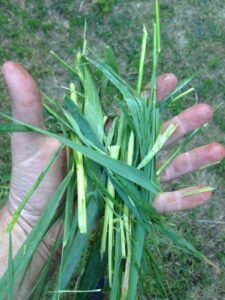
Although we have used common reed as horse feed before, it is only recently that we found out about the nutritional value of reed and how much of those nutrients can be absorbed by horses. This means we can get a forage analysis of reed forage, just as we can for haylage. This is thanks to research carried out at Wången by, among others, Malin Connysson (SLU). A few brief facts:
- Horses can absorb the nutrients from reed just as well as from hay or haylage.
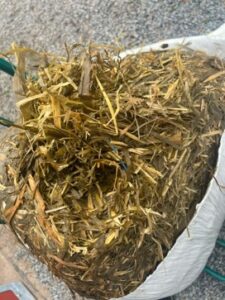
- Reed forage is coarser, and horses do not find it as palatable or as easy to eat as hay or haylage, which means it takes almost three times as long for the horse to eat it = prolonged eating time, and occupation.
- Reed has a high protein content relative to energy and a low sugar content. Good values for minerals and electrolytes. Example forage analysis.
- Reed forage is harvested at a lower dry matter content (approx. 40% DM), which makes it feel similar to fresh grass.
- Some horse owners worry about ensiled forage. Malin says: ”Most horses do well on haylage/ensiled forage and appreciate the increased moisture content. It is primarily the amount of fibre that determines whether the horse has firm or loose droppings, as a general rule, the more fibre, the firmer the droppings. And yes, there are occasional exceptions, horses that do not thrive on haylage/silage; we do not know why today.”
All results show that reed forage is a suitable feed for horses, link to nutrient analysis.
Good for horse welfare, with the greatest benefit for easy keepers
Many horses would benefit from the longer eating time and occupation that reed forage provides, but it is especially significant for easy keepers, who are often fed a restricted forage ration to avoid weight gain. At the same time, we know that a forage ration that is too low can lead to behavioural problems such as crib biting, aggression, frustration or even apathy, as well as digestive problems in the stomach and intestines, with increased risks of colic and gastric ulcers. This keeps many horse owners awake at night. With sufficient forage, that risk decreases, and this is where reed forage can be part of the solution!
In an earlier blog post where we interviewed Malin, she emphasised, in addition to doing a feed ratio calculation, the importance of: ”Make sure you have good hay with sufficient protein, so that youdon’t have to reduce the forage to provide protein via the concentrate feed. If the protein level in the forage is high, you can ’dilute’ it with straw.” Since reed has a relatively high protein content combined with lower energy, it works well combined with straw, which contains virtually no protein. This means that an easy keeper can receive an increased forage ration without using concentrate feed that steals eating time.
NOTE: if you turn the reasoning around, it also means that the properties of reed forage make it less suitable as the main forage for horses with high nutrient requirements. They simply cannot eat enough of it and then risk not getting sufficient nutrients and losing body condition. Small amounts of reed can, however, be used for all horses as a complement for increased eating time and occupation, but straw is of course also available as an alternative.
2. What experiences are there?
In SLU’s study, where six Icelandic horses ate only reed forage for eight weeks, all the horses ate well and thrived. They left slightly more feed waste compared with haylage. A few horses were excluded from the study from the start because they would not eat reed.
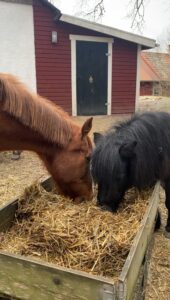
At the Vallentuna 4H farm, easy keeper horses are being fed reed forage. The farm has seen many advantages with reed forage: 1) they can now provide free access to forage overnight, 2) even during the day, reed forage is a large part of the ration. This has led to increased occupation for the horses. 3) The farm has also been able to reduce mineral and protein supplements, since reed forage itself contains a large amount of minerals. 4) The reed forage also contains more electrolytes (”salt”), which they feel has made the horses drink a little more.
Gunilla Lindgren, who works as an aquatic ecologist and nature conservation coordinator at Uppsala Municipality, came into contact with reed forage through a project at work. She also has her own Icelandic horses and is active in the Swedish Icelandic Horse Association. Gunilla buys reed forage and gives her horses a mix of reed and haylage. She sees benefits in being able to feed more and increase the horses’ eating time. She also has a horse with a metabolic disorder, insulin dysregulation, with high sensitivity to sugar; for that horse, the reed is perfect.
Two feed rations with examples of eating time and cost per kg of forage
How much reed forage you can mix in depends on many factors: the horse’s nutrient requirements and the nutrient content of your own hay/haylage, and whether you have access to feed straw, so yes, you need to do a feed ration calculation!
We have made two fictional feed ration calculations for two easy keepers (healthy, adult, not pregnant or with foal): Donna, an A-pony weighing 130 kg, and Herkules, a coldblood weighing 550 kg, and compared eating time, with and without reed forage. In our examples, the haylage had a ratio of 5.1, so slightly less protein than the horse needs, which meant that without reed forage, both horses needed a small protein supplement in the form of concentrate feed plus minerals or a selenium supplement.
Donna’s eating time roughly doubled (from approx. 1 h 40 min to 3 h 15 min) when the ration was changed:
- from 2 kg haylage, 1 kg feed straw, 1 dl concentrate feed
- to 3 kg reed forage and 2 kg feed straw
Herkules’s eating time also nearly doubled (approx. 4 h 20 min to 7 h 40 min) when the ration was changed:
- from 7 kg haylage, 1 kg feed straw, 3 dl concentrate feed
- tto 3 kg haylage, 5.5 kg reed forage, 3 kg feed straw
Both horses now have almost twice as long an eating time and slightly more forage in DM per 100 kg of horse, which we know is good for the horses’ mental and physical health, an important part of horse welfare. Both, but especially Donna, would still benefit from more occupation, e.g. suitable branches and perhaps a slow feeder for the straw.
We calculated that haylage and feed straw cost SEK 3.50/kg and that reed forage cost (2026) SEK 8/kg. This means the forage cost increases in our examples, but in return we did not need any concentrate feed, and it is impossible to put a price in kronor on the value of the increased amount of forage, the eating time and the occupation. For horses that already have problems, the benefit is obvious.
3. Where to find reed forage today, and what it may look like in a few years
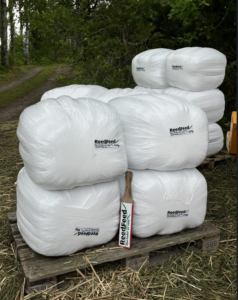
We have talked to Fredrik and Erika, who run the company Sjöutsikt, which is currently the only company harvesting and selling reed forage; their feed is called ReedFeed. They started their business out of concern for the Baltic Sea environment and have developed a unique harvest boat that is gentle on the lakebed, Reedeco, which is propelled by an air propeller instead of one in the water, the boat glides forward like a sled. They harvest and chop the reed just above the water surface and ensile it directly on site in bales of approx. 50 kg.

Sjöutsikt (based in Stockholm County) has participated in several reed projects and has, among other things, harvested the reed forage for SLU’s research project. Today they sell reed forage on a smaller scale to around 30 customers who buy the bales directly from the harvest site, which has primarily been in the Roslagen area. The harvest boat is easy to transport, so harvesting could take place anywhere in the country.
Sjöutsikt is also developing a horse bedding product. Winter-harvested reed could then be used, even though the environmental benefit is lower; only 10-20% of the plant nutrients are removed then, since the reed has sent nutrients down to its roots over the winter. The reed is chopped, and in Sjöutsikt’s first small trials it has shown good absorbency, especially for horses on bedding. Several companies that took part in a project in Finland have tried to develop a product resembling garden soil/compost, which can, among other things, be used in the garden instead of peat-based growing media, or potentially as horse bedding. This could replace our use of peat, which has a negative impact on both the climate
Since this is a new feed that requires entirely new machinery and volumes are still fairly low, the feed is currently more expensive than haylage and hay. For Sjöutsikt to make the business viable, they need to apply for and receive environmental subsidies to harvest reed.
For the 2027 season, Sjöutsikt is developing an additional harvesting header as a complement to Reedeco. A few years from now, Sjöutsikt expects to be able to series-manufacture Reedeco and the new harvesting header to sell, rent out or lease. If you are interested in harvesting, contact Fredrik and Erika via Sjöutsikt.
This means reed forage may become more available in the coming years, and it may be worth joining their waiting list. You can do so by email at vassfoder@sjoutsikt.com or via the contact form at vassfoders website.
Great potential for coming years and a close link to the environmental impact of our horses
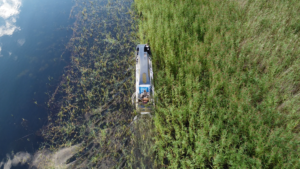
In Sweden (and Finland) we have many lakes and watercourses as well as a long Baltic Sea coastline. We also have major problems with eutrophication and reed encroachment. We simply have a lot of reed, so there is great potential to harvest more of it.
The reason we want to harvest more reed is the eutrophication, which is mainly caused by nutrient runoff from agriculture, wastewater treatment plants and pastures such as horse paddocks (e.g. project Varjeskiträknas.)
Eutrophication leads, among other things, to the reed growing unnaturally vigorously, and lakes can become entirely overgrown. When you harvest and remove the reed, you remove nutrients from the lake or coastal area. Less reed decomposing in oxygen-free conditions below the water surface also means smaller amounts of methane gas released into the air, which is good for the climate. If we can also use reed bedding instead of peat, we further reduce the climate impact.
If horses eat reed forage (and we use reed bedding), we help reduce eutrophication: the nutrients in the manure, from eutrophicated lakes and seas, can also enable the farmer to reduce purchases of fertiliser that has been mined or required a lot of energy to manufacture, so-called mineral fertiliser or synthetic fertilisers.
When harvesting, consideration must be given to the animals living in the reed
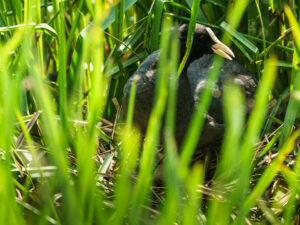
At the same time, reed beds are important habitats for many animals; above all, they serve as nurseries and breeding grounds for many species. Waterfowl, songbirds, fish and amphibians raise their young there. Which in turn means that many insects must be able to live there.
So it is both important to harvest more reed, and that it is done to the right extent and at the right time. Each site requires its own assessment.
A seller of reed forage should therefore be able to account for:
- Where and when the harvest took place,
- What assessment was made regarding the impact on nature and what consideration was taken during the harvest. For example:
- Describe why harvesting reed was assessed as positive for the ecosystems, and to what extent.
- What consideration was taken for species such as nesting birds, fish fry and frogs. If threatened species are present, harvesting must not take place in a way that affects that species’ habitat.
This is something Sjöutsikt can account for; for example, they always harvest in July, after the nesting period, and survey the area with a drone before harvesting.